Wednesday, April 2, 2014

Lord of the Rings: Living Card Game FFG

Not really a review, more of a "hey check this out".

Lord of the Rings: LCG is a card game made by Fantasy Flight.  Its a living card game, meaning that you do not buy randomized packs and need to trade or find rares and uncommons to compete.  The "boosters" are always the same cards, and always the max number of them you can have in a deck.  The expansions come a couple of times a year and are basically 3x the boosters with new characters to be as.  When it comes to Lord of the Rings:LCG, you buy your starter set, and whatever else you feel like getting, and you're done.  Why?  Well its a special game.

There is no competing with other players in LOTR:LCG, because you play it cooperatively.  It doesn't matter if Tom has 10 booster sets and 2 expansions, because that only HELPS you, because you're on the same side.  In the game, you and your friends are presented with a series of randomized quests that come from a deck that makes your story.  Both of you pull from a deck that you make from your own cards to try and proceed through the quest.  Quests have varying difficulty and special rules set up from the get go, so there's plenty of reasons to play a quest multiple times.

The additions to the game come as booster packs with a new character, a new quest, and new cards that support this quest.  Some of the cards are new monsters, some of them are new equipment or events.  A couple of times a year there is an Expansion released.  This expansion is typically 3x the amount of cards as a booster.  You get several new heroes, quests, and all the cards needed to support it.  For example: one of the first boosters adds "The Hunt for Golem", and a Bilbo Baggins card as a character.  One expansion adds Moria, 3 dwarven characters for you to play, and 3 new quests to partake that happen inside Moria.

The game can also be played as a sort of super solitaire, but the harder quests are typically too strong for this play.  Its not impossible, but its better to use the weaker quests to practice on.  Practice you will need, because this game is hard.  If you are not cheating, you will likely be trying to finish the 2nd quest in the starter deck for many many sessions.  The 3rd one will wipe the floor with you until you're a veteran.

Reviewy type stuff?  The art is amazing.  The pictures are not abstract, and the action in them is inspirational while playing.  It sets the mood perfectly.  The theme of the game works.  There is another living card game set in a popular science fiction universe where you will fight space ships with your overly large horned rams... its silly.  Lord of the Rings:LCG is perfect.  You gather a group of adventurers.  You equip them with legendary weapons and armor, and you slay monsters in locations while trying to finish a quest.  There is no abstraction, you actually make a story as you go.  You are ALWAYS happy to see Gandalf.  If I have one complaint about the game, there are too many little pieces for my liking.  To give the game makers credit, there's a  lot less little knick-knacks than Fantasy Flight usually puts in games, but its still a lot for this type of game.

Chances are you're going to play it wrong the first few times.  Either watch someone on Youtube explain it, or play with someone that really does know how to play.  Its ok though, even playing wrongly, you'll have fun.  It really does scratch that deck making itch that I have been missing since quitting Magic.  Unlike a lot of "Magic" alternatives, you will be making, refining, and altering deck lists just like if you were playing Magic.

Wednesday, March 26, 2014

Living Card games: LCG vs CCG

If you are in any part a nerd, then you probably know what Magic the Gathering is.  It is what we call a Collectable Card Game, and it is the most successful of its kind.  Every year there are 3-5 "releases" of cards that you have to purchase in randomized packets.  These cards are organized into rares, uncommons and commons, but you do not know what you're getting ahead of time.  The game itself is played by two or more players putting together collections of these cards into a Deck that they draw randomly from as they play.

There is a lot of stuff said about this type of game play that turns people away from it.  First, you have to spend lots of money to get the cards you want to play with.  Second, there is always a new set coming down the pike in a few months, so you'll never "catch up".  Third, they raise the power of the cards as time goes on so that if you have an old set of cards, chances are you can not compete.  True or not, the thought of these turns people away.  One of those people is me.  The last year I played there was 3 mini-releases, and 2 major releases.  That is a rare occurrence, but Coldsnap counted as legal, so it was true.

Someone thought of what we now call Living Card Games a while ago.  Parts of it crept into other games in the past 10 years, but no one took it and ran with it like Fantasy Flight does now.  The first that got close was Munchkin.  There are many editions of Munchkin, and technically they all work together.  I remember the Good Fairy pack was put out in a "booster pack" wrapper, as if it was Magic:TG, but every pack had the same cards.

So what is a Living Card Game?  Imagine there is a card game, like Magic The Gathering, but all boosters and expansions came in complete sets throughout the year.  There is no need to rebuy sets because all the sets have the same cards, always.  You do not get randoms, you do not need to trade for extra cards, and you do not need to go hunting for rare, out of print stuff.  You buy the set, and you're done.  Each set comes with the maximum number of copies of a card you are allowed to have.  Now all you have to do is get good and game.  More money does not equal more power.  Your opponent will not have this vast collection that you could never touch.  You start on the same level playing field.

Yeah, you can still spend money, especially if you come into a game late, but no where near the amount Magic:TG requires.  I had a $50 a week habit for a few months the last time I played, and I was nowhere near a huge collection.  In most Living Card Games you can buy the last 2 years worth of cards and have change left over for lunch at the mall.

My favorite is Lord of the Rings by Fantasy Flight.  Its actually a cooperative Living Card Game, and each booster and expansion is a new series of quests for you to complete.


Thursday, March 13, 2014

FATE Points vs Bennies

On the surface of things, Fate's "Fate Point" and Savage World's "Benny" systems look similar, but if you take a moment to learn about them you will see that they serve different purposes.

What is a Benny?


In Savage Worlds you can be awarded a Benny by the GM(or by other players in some alternate rules).  This makes Benny rules kind of liquid, as you simply get them when someone judges what you do merits it.  This makes them flexible.  If the GM wants more action, he'll reward the players for being more proactive in things.  If the GM wants clever resolutions to problems, he'll start rewarding that.  It is kind of like Dog Treats.  

Some people do not like this non-codified giving of bennies because someone can become a "favorite", or you can encourage bad behavior.  Someone making an offhand joke about a situation makes everyone laugh wildly for 5 minutes, so they get a benny.  Now for the next 30 minutes, everyone's cracking jokes trying to get the next "you're the funniest person" benny.  This does not even take into account straight up favortism from a bad GM.

In the end, Bennies are not nearly as strong as Fate Points.  Bennies are "do overs".  They let you re-roll an action that you are not happy with.  If you're trying to diffuse a bomb, its a second chance at a better shot.  If you get hit by a bullet, that benny can be a split second dodge out of the way.  If you're injured and bleeding, that benny can be a shot of adrenaline that pushes you off the floor and into heroism.  Bennies are more plentiful and fly around in use much more than Fate Points.  They create tension and extreme acts of heroics that cause Savage Worlds games to be more "seat of the pants" style than other games.

What is a Fate Point?

Fate Points are earned by a player putting their character through hardship.  To get a Fate Point you have to invoke a negative aspect of your character, and fail at some task or ability. The favored way of getting Fate Points is to spring the failure only after you build up your idea as awesome and great to the group.

Fate Point acquisition is a sort of anti-min/max thing built into the game.  It forces you to think of real disadvantages of your character that you can call on in situations so you can get these Fate Points.  If you choose a disadvantage that rarely comes up(pineapple allergy), then you're going to find it hard to come by Fate Points.  Fate Points are not in the hands of a GM, and so there is not the potential for abuse as there is with Bennies.

Fate Points are sort of your "dream powers" if you go by the idea that Fate is sort of a group of lucid dreamers trying to make a story together.  You can use them for mundane things like adding +'s to your roles or -'s to other's rolls, but the real power is when you take narrative control of a situation.  You can find clues, you can know contacts, you can create "bridges" between the players and the goals that make it more interesting or move the story along.  You find out the bad guy's fortress is  hidden, you can use a Fate point to know a former guard is in prison and the group can go interrogate him for the location.  You get into a car that won't start, spend a Fate Point to do the "start up" routine your shitty car in college did and it causes the car to work!  Stuff like that.

On the flip side you can also change it to the detriment of other characters.  The bandits are on top of the train, so you spend a Fate Point to say "a storm rolls up out of the plains, causing heavy wind and rain" now the bandits have trouble moving while up there.  The Non-player character in the corner of a gas station is actually an undercover cop, and joins the group in subduing the criminals.  It can be simple too, spend a Fate Point to make a gun jam.  

End.

So that's the differences.  There are some more, but this is enough of an explanation to get you started.  Bennies are more free for the awarding, but are more rule tied to their usage.  Fate Points are very codified in how you attain them, but the use of them is very free form.  Both are really cool additions to the old gaming formula, and even though I'm pretty much the GM of games I play, I love anything that takes control away from me, and gives the players the ability to affect the world.

Tuesday, March 4, 2014

Initial Thoughts: FATE Accelerated

FATE Accelerated is a newer version of FATE, which in itself is a variation of FUDGE.  You don't have to know the difference or the history... though I might do a history piece of on it one day; gotta have that blog fodder, you know?

Evil Hat Productions are old hat at doing genre specific versions of Fate.  Their releases garner almost universal acclaim and they have even got awarded top honors a few times for new RPG.  I initially was very skeptical of these honors, because I had a prejudice against Fate.  I wondered if what amounted to "setting" or "campaign" books should be considered different games altogether.  I still haven't shaken that thought, but it might be due to my ignorance of the system.  Lately they have gotten away from Genre or licensed property games and have been trying to produce universal "works for everything" systems.

So I came across this dilemma.  I love 3x D&D and I love Savage Worlds, but if I was ever going to make a Harry Potter Universe game for my girlfriend, it would require SOOO much work and research into the spells.  Then, at the end of the day, the game would not feel like Harry Potter because they don't care about how many times you can cast a spell, or knowing specifically the distances and all that.  The game SYSTEM would care, but the characters should not.  Then I read about Fate Accelerated's stat system.

Fate Accelerated was a Kickstarter project.  They have the PDF for free on the website.  Really, its there, all legal and everything, go grab it and have yourself a read(link at the bottom if I remember to put it there).  It was designed to be a quick version of Fate so that you and your friends could just decide to play, and get characters and a world going in less than 20 minutes.  This "group together" thing is emphasized by the fact that its almost impossible to finish a character without the group's input into relationships and stuff.  The game is geared to make NEW stories right when you all sit down.  This is not a game for those that like to create self contained characters and GM's that like to create a novel for the group to play through, this is not that kind of game.(the GM could easily keep a list of settings and even scenes though)

Fate's stat system is a system of "approaches" instead of physical/mental attributes.  They describe how your character approaches a problem or situation.  Instead of muscle and wisdom, your approaches are: Careful, Clever, Flashy, Forceful, Quick, Sneaky.  That's your stats and basically your "skills" all in one go.  In my example, you do not make a huge list of spells you know; you simply say "I use my exspeloramus(spelling, I know) spell to cleverly knock the wand from their hand".  The GM can argue that's force, but in the end the group settles the discussion and there ya go.

You do get some stunts, but they just augment your abilities instead of being something you'd use as a spell list.  Again, taking Potter, you might list "Petronus materialization" which means that when you cast your expecto Patronus spell, instead of being a cone of force(like Early Prisoner of Azkarban), you summon the spirit creature(like in Order of Phoenix), giving you a +2 to things it would help with.  Harry might also have that summon spell that, but his stunt is that he can call his broom from insanely long distances.  You get the picture... I hope.

The Fate points and how the game works is really neat too.  It gives the players a bit of "GM'ing" ability while playing, so that they can create their own parts of the story.  They can create problems so that they can get Fate points, or they can create advantageous conditions to help during a challenge.  Someone can just say "its raining" and there it is, raining.  Someone can say "I check under the doormat and find the key" instead of going through what the GM planned.  That might scare some GM's, but its not quite that easy to alter the world, you'll have to learn the system to find out.

My girlfriend said its like playing a dream where all the players are lucid dreamers.  Since I'm a lucid dreamer, I think this analogy fits really well.

I'll do some more Fate related posts later.  I want to talk about the differences between Bennies and Fate Points, and I might give some better examples on how the players create the world.

Fate Accelerated Official site

Wednesday, July 24, 2013

Mulligans, Bennies, and Do-Overs.


I'm about to get hardcore golfer lingo all up in here, so try and follow if you can.  Mulligan... means "do-over".

Re-rolling was the most audacious of moves when I was a teenager.  You don't even ask for that, you might get laughed out of the room or hit with a mountain dew can(actually we had high powered Ginseng pills from GMC).  Even back then though, I was a "relax, go with the flow and trust your GM" kind of GM.  Random failures were not going to be a death sentence(unless it was dramatic, but I tried to convey those situations to build drama), and most of the time failures ended in awesomely funny stories.  Many failures are still part of our "remember the good old days" conversations among my long time friends.

Then I found Savage Worlds.  I first read about Bennies and though "nevermind, screw this", but then I kept reading.  Savage Worlds flies off the handle very easy.  Their dice "explode" or "Ace", which means if you roll the highest number on a dice, you can re-roll that dice and add the result.  Randomly you could get 3 aces in a row and do insane amounts of damage.  Bennies figure into that, if things just swing wildly out of proportion, you have some "do overs" you can play.

The do over was built INTO the system, not tacked on.  That is an IMPORTANT aspect.

Tagging on do-overs in a game makes the game heavily favored on the players.  I would never do that to Dungeons and Dragons or Pathfinder because it would stack things in favor of the players an obscenely strong amount... and besides, D&D with do-overs just "feels" all icky.

I know D&D Next is still in testing, but the head guy there has revealed they are completely aping every popular thing in modern gaming to try and save their sinking ship.  This includes "Inspiration" which is really just another name for Bennies.  I'm hoping they do not make this into the game itself, because frankly with "Wild Dice" already figured in from the start, adding Bennies just makes it feel like a Savage Worlds home brew.


Bennies are not the sole providence of Savage Worlds though.  I do not believe the D&D Next designers said "Savage World's bennies are huge, let's do that".  The "new new Hotness" is FATE.  It is blowing up the kickstarters.  FATE's mulligans are slightly different and must be tied to role play aspects of your character.  While FATE and Savage Worlds was first published the same year, the precursor to Savage Worlds, the game known as Deadlands, had Bennies way back in 1996.

A lot of the games based on FATE have them and have gotten tons of awards.  The Dresden Files game is based on FATE directly.  BULLDOGs is another.  FATE kickstarters are blowing up all over the place with FATECORE being the sort of "everything" FATE book getting lots of funding.

The big winner of the awards this year was Marvel Super Heroic Role Playing Game.  It had bennies built into it too, and were much more like FATE than anything else, but it had its own quirks and intricacies.

All this, and so why am I feeling kind of icky about D&D Next getting it?  Well... its the old man trying to be young when we love the old man thing all over again.  Examples.  Hulk Hogan decided to become an anti-hero because Stone Cold Steve Austin was tearing it up in ratings.  Final Fantasy goes for action combo combat, open world free form questing, and MMORPG like crafting... when the best Final Fantasy games sell and are praised for being innovative, not being a follower, being... Final Fantasy.  Lost Odyssey was made to be a Final Fantasy and stuck with traditional gameplay, and its widely regarded as the best JRPG of its generation, while FF13 is lambasted(despite the fact I loved it).

D&D needs to be D&D again.  A game that feels like an evolution of 1st-3rd.  Maybe take a couple of good parts of 4, and bring some new stuff for 5, but make it feel like D&D again.  1st-3rd got a lot of things right, you do not need to reinvent the wheel.


Wednesday, July 17, 2013

The true response to "The Dungeon Masters"

In 2008 there was a documentary filmed called 'The Dungeon Masters" which was marketed and sold under the disguise of being something positive for the hobby of Role Playing Games.  It was shoveled out at Dragon-con, Comi-con and any other number of places.  It was even promoted(before they saw it) at reputable hobby websites.

This movie was utter garbage.

This documentary does just as much harm to the hobby as Jack Chick comics.  It "portrayed" 3 socially damaged people in a way that made the hobby look poor.  I say "portray" because I do not know these people, and like any reality TV(because this so called documentary was one step away from Honey Boo Boo), much of it is made in the cutting room.  I suspect this because I can easily see the director saying "hey, let us dress you like an elf for a regular day and just see how people react" and then portray that as what the girl does every day.  The guy that is so obsessed with getting his home brew published that he neglects his family and actually knows nothing about publishing or how much these poor "authors" of dungeon adventures actually make... maybe that guy really does not spend all his time doing that.  Maybe this guy's children are well taken care of, and the stress between them is because there's a fucking film crew in the room.

Anyway.

Lots of people of our hobby saw this trash and said "I can do better."  And that is what this post really is about.  People doing better than "The Dungeon Masters"

Today I have 2 examples.

First up is a small one with a good message.  Role Players are your mailman, your waitress, your boss at work, your lawyer.  They come from many different backgrounds and that it is about getting together with your friends and playing a free form, thought provoking story together.  It is called:  Heroes of the Tabletop.


Another one is this wonderful documentary for PBS, yes, it was actually shown on TV.  Its about what RPG games are, what they entail, and their influence on modern life.


These are the real responses to "The Dungeon Masters".  Far more constructive and better for our hobby than any rant I could do about how shitty "The Dungeon Masters" is.

Friday, July 12, 2013

The Beginning(of the blog, of my RPG life, of modern geekdom)

(this is a reprint of mine from an older blog with more detailed history of the game added at the end, I figured this was as good a place as any to start)

Some people get a kick reading about how people come into a hobby, and some people get a kick writing about how they get into a hobby.  I was not going to do a post like this, but Wil Wheaton changed my mind.  Well not fully Wil, the new hip "old school revival" trend had something to do with it too.

I'll start with Wil.


If you do not know Wil Wheaton, he played the young kid on Star Trek: The Next Generation.  He's also somewhat of a geek celebrity now, and has thrown in his geek celebrity with Penny Arcade to make an even bigger geek celebrity and he's also "evil Wil Wheaton" on The Big Bang Theory.  Here is his personal blog, check it out: Wil Wheaton dot Net


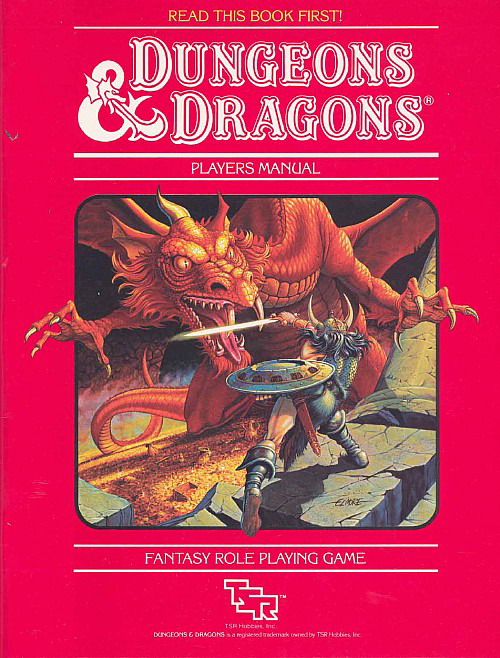
He has been on vacation apparently(the blog told me.. I do not stalk Wil Wheaton), and in his absence he has been auto-re-posting some old stories of his.  One of them was about the death of Gary Gygax because he died on March 4th, ironically DM's day(it was DM's day 7 years before his death, they are not celebrating him on his death date as I once though and have a pet peeve of).  Anyways he says that his aunt gave him the red box Dungeons and Dragons Basic set.  The set printed in 1982(the year I was born).  He never got to play with anyone, so he made characters for himself and played through dungeons on his own, by himself, in his room.


My own story about how I got into Dungeons and Dragons begins at a yard sale.  Yard sale finds of D&D are the classic method of being introduced to the game.  Several people on podcasts I listen to, and a few on blogs I've visted retell this same beginning.  My own yard sale seems almost magical in my mind now.  I am not writing that to be all mystical and stuff, I did not think of the place all that much before this.  I mainly thought of the car ride home where I read through the book.  The house that we went to was not a place we frequently went to yard sales at.  I do not remember ever going there again.  It was at this house I found it.  The house was brick, with a huge flat front yard of grass.  You could barely see the brick though because hedges covered the walls up to the windows.  It was a sunny day, but you would not be able to tell at the sale table because two MASSIVE trees sprout up near it, shading the entire huge yard underneath.

*only accurate in my mind

Anyway, I got the book, I do not remember how much but it was probably fifty cents.  I was into reading lots of Greek myth and King Arthur was like the coolest thing I had ever read about.  Also I had played through the original Dragon Warrior as well.  This book blew my mind, and I know it took me a long time to read and actually understand what it was saying.  It was the player's book, and it would be years later that I would find a DM's guide.

Anyway, I do have one thing in common with Wil Wheaton's story: I never played Basic Dungeons and Dragons.  By the time I had friends to play with me, I had a Advanced Dungeons and Dragon's book.  Being kids, we saw "Basic" and was all "well we aren't kids anymore, we need to be playing Advanced.  It is more REAL"

Wil's story inspired me to read up about our Basic set that we never played.  It all started with a man named J. Eric Holmes.  He created a book(which I actually have a copy of from the 25th Anniversary Box) that is literally the original Dungeons and Dragons paired down a bit.  It was released at a time when AD&D was out, and is thought to hearken back to the "old days" of 1977(this was around 1980... so.. yea).  Its combat was more like the old Chainmail game and did not reflect the new changes to the game that Gygax had made.

This is why Tom Moldvay came in to do his version.  Moldvay made his "basic" version much more like AD&D, and reflected how the game had grown.  Fighting-men were renamed Fighters and different weapons did different damage, just to name a few.  By now, D&D Basic was its own separate game, and to reflect that there was a sequel called D&D Expert.  Now instead of just being a beginner's game, it was a graduated set of rules that reflected not the player's skill, but the character's skill.

Big changes came between Moldvay and Mentzer's eras.  Big changes in TSR management, the ridiculously stupid Satanic Scare of the 80's, and a re-dedication to quality of product.  No longer would D&D look like something put together in a basement.  Mentzer's editions lasted through to the 90's and it "feels" like that era's AD&D books.  The layout was done with thought and care.  The artwork was done by the famous Larry Elmore and friends.  Mentzer also took the last bit of "basic is for beginners" out of the game, and wrote the game to cater to Adults rather than a child audience.

Mentzer went past Expert and brought the characters even into the "Immortal" era of traveling planes and shaking hands with gods.  There were rules for such things as governing lands that AD&D did not even cover, and people used his books to help them GM such occurrences.

So that's the story of this funny thing, Dungeons and Dragons Basic.  What started as a small intro to rules(similar to the free starter rule PDF's of today) and evolved into its own game that is remembered by famous and no-names alike.