Showing posts with label Dungeons and Dragons. Show all posts

Thursday, July 24, 2014

3 Defining Features: Dungeons and Dragons 5th Basic


Here we are, presented with the 5th Edition, Dungeons and Dragons Basic set.  The Basic set is given free of charge from Wizards of the Coast's website, in a sort of generous but perhaps brilliant maneuver.  They realize people can play a stripped down D&D for free from a multitude of areas, but by giving away the Basic 5th for free, its more likely that the pool of 5th players will grow.  If the amount of people able to play 5th grows, then the paying customers will have more chance to use the material, and maybe buy more or grow brand loyalty.  Good stuff.

Defining Feature #1: D20 Base

This is Dungeons and Dragons that feels like Dungeons and Dragons.  This is accomplished by being rooted in 3.X's D20 system.  Grid combat and 4th Edition ability systems are thrown out and we go back to the evolution of 1st(through Unearthed Arcana), 2nd(through revised) and 3rd's game systems.  You have your 6 Abilities, you have saving throws(though now based on your 6 abilities), you have DC checks.  Your characters level, and have a class.  Combat is a round consisting of turns taking in initiative order.  You roll D20 to make your attacks, to make your saving throws, and to determine outcomes of various types.  You characters have hitpoints and fight with monsters to reduce one side's hit points to zero before the other.  You have armor classes and dexterity bonuses for avoiding damage.  If you've played Dungeons and Dragons, you pretty much know how it goes.

Defining Feature #2: Advantage and Disadvantage

When I read people's reactions to Advantage and Disadvantage at first, they think its just a simple re-roll gimmick.  They assume its a Savage Worlds "Benny" mechanic or some sort of Fate thing.  They are right to an extent, but what you're not prepared for is how pervasive the Advantage and Disadvantage system permeates the game.  Basically you roll 2D20.  If you have Advantage, you take the higher number.  If you have Disadvantage you must take the lower number.  You think this is mainly for combat, and you'd be wrong.  If you help someone with a skill, you give them Advantage.  If you get distracted, you get Disadvantage.  If another player inspires you, you get to use Advantage.  So much math and sub-system equations are eliminated by the use of Advantage and Disadvantage.  The best part?  It scales PERFECTLY.  In former games, if you get a +2 for helping, eventually you outlevel that, and a system has to be placed in so that at higher levels you get more.  At low levels a -2 to hit on a creature is a huge deal, but later you basically ignore it.  With Advantage and Disadvantage, they stay the same from level 1 to level 30.  Having disadvantage sucks just as much at high levels as low levels, without the need for modifiers.  Having Advantage is awesome no matter when you get it.

Defining Feature #3: Backgrounds

The new character creation system was invented to satisfy the old fans and the new when it comes to roleplaying.  A full new genre of games is very popular, and there's an argument that "story telling" games are a rejection of the miniature wargame style rules of D&D 4th.  Role Playing gets put back into the game with 5th.  When you make a character, you choose a Background.  These Backgrounds supply an origin story, a personality, an ideal to live by, and a flaw that hinders you.  Maybe you are a folk hero, a peasant that saved a town through your brave action.  Maybe you are a criminal, a forger of documents that guilds turn to for their services.  Maybe you were raised in a demon church and now reject their teachings.  Backgrounds are great and they affect your choices for skill and equipment use, and guide you in making your decisions while playing.  I can see companies making entire books of backgrounds with the random tables that help you create your character as presented in the Basic PDF.  I would buy it, and I know many others that would as well.   As presented, Backgrounds are more guidance than hard rule, but with a few tweaks you will have your Role Playing tied to your Roll Playing very easily.


Thursday, July 17, 2014

Dungeons and Dragons: Art Eras


With the new edition of Dungeons and Dragons, we come to the point of what I hope to be a new "look" to the game.  To me, Dungeons and Dragons' editions are represented by the artwork that was presented to me when I learned the system.  For me personally, there was the nebulous time where I had 3 different versions of the rules to cypher through.  It was when I inherited my cousin's extra book set.  In it were modules from 1st Edition, the rulebooks of 2nd Edition, and then I had my own set of "Basic Dungeons and Dragons".  The common thread to all of those was oil paintings.  In my opinion, the highest era of artistry in D&D was the 80's when the Dragonlance crew was making amazing artwork for the entire line.  Here are some examples:

The dragons in these paintings seemed real, and to this day, when I play, this is what I imagine in my head.  A sort of realistic style to a fantastic genre.  Look at the character designs.  They are rooted in what people would actually wear.  There is some historical accuracy to the pieces of armor, the clothing being worn.  Things seem to make sense(except for female armor, but at least its not metal bikinis).

When 3rd came out, I loved the artwork.  As you can see in the examples below, the team went a little bit JRPG/Comic style.  Characters wore stylish armors with buckles, straps and bags everywhere.  The weapons were very much not rooted in reality, being overly large and bombastic.  It was a huge change from what 2E was presented in the Revised edition(black books), which was encyclopedic and not very exciting.

With 3rd being as popular as it was, they continued with this art style.  We have had 15 years of this art dominating the industry now.  With 4th Edition, the art style did not get changed all that much.  With Pathfinder trying to tell everyone that they were where the 3rd Edition fans should be going, they used the 3rd art style.  In my opinion, much of what Pathfinder has put out has finally rivaled the Dragonlance stuff.

But that's 15 years of the same style, through technically 4 editions of the game(3rd, 3.5, 4th and Pathfinder).  While great, I think a change in art style really shows a fresh new start, something 5th Edition D&D desperately needs.  Here's some of the cover art.

Its got a solidness to it that reminds me of the oil paintings from the 80's, yet the character designs are still the exciting super hero kind of look to them.  There have been some scans of the inside artworks of these books, which I will not repost here, but the artwork inside is just as "solid" as the covers.  Textures, metals, stone, all look like they would feel instead of having a colored style to them like the previous.  I have to say, I approve of this.  It really is sort of blending the old with the new, which is the theme for this edition.

Thursday, May 29, 2014

Dungeons and Dragons/Pathfinder; Schism Explained

I'm going to try and do a semi-simple explanation with less hate and bias, but I can't help having a little, I'm not a journalist.


An Open Game

The original Dungeons and Dragons publishers finally floundered in the 1990's from bad decisions and low profitability.  The grandfather of modern fantasy gaming was dying and the upstart company, Wizards of the Coast, took the money it made off of Magic the Gathering and rescued it.  Vowing to treat it right, they put together a team of the most respected free lance content producers to create a new version of Dungeons and Dragons for the modern era.  This group of free lancers created the most free lance friendly gaming system of all time.  They pitched an "Open Gaming License", a sort of open source for the gaming world where anyone would be allowed to produce content for Dungeons and Dragons and SELL it along side official releases.  This would ensure that there was lots of new stuff to buy without WOTC being burdened with doing it all themselves.

A Turn of Events

Wizards of the Coast was bought by multi-national conglomerate Hasbro.  Hasbro has long been run by CEO's instead of gaming people for many years.  They did not understand how a company could freely give away permission to make stuff for games, and they did not understand why a company would not cancel a line that did not make $50 million a year, especially when Magic the Gathering was making over $200 million a year.  The caretakers of D&D from the 90's were bullied out or fired from the company, and Hasbro got a group of people they could work with.  They wanted new editions.  WOTC tried to tell them that new editions were not in their interest, and so they compromised and made a 1/2 edition, Dungeons and Dragons 3.5.  A few years later Hasbro had enough of the stalling, and 4th Edition was to be created.

A Change of Audience

Wizards of the Coast needed a "Hail Mary" pass to appease their employers.  Recently World of Warcraft came in and took an industry from 200,000 subscribers as the "top" tier, and turned that into 10 Million Subscribers.  WOTC would now use this as the basis for their new 4th Edition.  Unlike 1st to 2nd or 2nd to 3rd, 4th Edition would scrap much of the game and make its own.  The current audience was gambled, put on the line, to try and get a new, larger, higher spending audience.


The Great Schism

Much like the often used "schism" plot line in Dungeons and Dragons stories, there was a great split among gamers.  There have always been die hards of certain editions, but this schism was large enough to affect the sales.  The internet created a huge underground movement to keep playing 3rd Edition, and allowed them all to gather.  Hobby stores were split, and several could not even keep 3rd and 4th Edition materials in the same area for fear of arguments breaking out.

Enter Paizo

Wizards of the Coast needed to cut their waist line.  The company never put much faith in modules or magazines, but kept them around for "tradition".  They decided to sell contracts for companies to take over the duties of making these things.  A group of fans in Redmond Washington decided to make a new company for the reason of buying the rights to do these things, they called themselves Paizo from the Greek word that means To Play.  After a few years, WOTC decided to not offer the contracts out any longer, and so Paizo found itself with nothing to do, but a whole company ready to publish.


Finding the Path

Paizo looked around and saw the schism.  It was already known that 4th Edition was floundering.  Paizo got out the old book of Open Gaming License and researched it to see how far they could push this license.  In 2009 they released Pathfinder, a game that is basically Dungeons and Dragons 3rd(3.75) reborn.  Paizo put a new effort into constructing adventures and gaming aids for players.  For the first time since the 1970's, Dungeons and Dragons(in the guise of Pathfinder) was being created by players that did not have CEO's from other industries looking over their shoulder.  For the first time since it was created, Dungeons and Dragons was outsold by another RPG, Pathfinder was King.

A Turn Around

If there's one thing they can convince Hasbro to let them do, its create a new edition.  WOTC by this time had given up on 4th Edition, cutting out all publishing of material a full 2 years ahead of the announced new edition.  They went back to the drawing board, and vowed to go back to the older style of gaming.  They would release alternate versions of the rules for whatever edition you loved to play the most.  For two years they playtested and developed a new edition.  We're about to see the clash of the Titans on a common battlefield.  The new D&D was developed to compete with Pathfinder with a rejection of 4th Ed and a re-embracing of the old style game play.  People are starting to ask if Pathfinder is going to evolve and change.  Paizo made itself on the back of not changing, but will Pathfinder start showing its age?  Many believe an RPG's life is about 10 years(WOTC is pushing out new D&D's much faster lately), and the back bone of Pathfinder is past that now.  Online gaming is getting to be "normal" among many groups of players, and Pathfinder was developed without this in mind, while 5th Edition D&D does have that in mind.  It will be an eventful year.


Friday, April 4, 2014

The John Doe Era: a group story building idea

I came up with an idea the other day for a Savage World game, and thought it could be used in several other games as well.

Savage Worlds has this mechanic that happens during down times(like if the group is camping for the night, or staying in a motel between cities, etc) where you invoke an "Interlude".  In the Interlude, a character is given a chance to expand their character's story and personal life out of the context of the game.  A trend that started in the Happy Jack's podcast circle of friends was that the GM would get an Interlude out of someone without them realizing they were Interluded.  Speaking from experience, it is hard to get an Interlude going without people realizing, and without that, the Interlude can feel artificial and out of place at times.

My ideas lead to me doing directed and cooperative Interludes.  I would pick something that happened in the last session and ask the player to talk about it with the group in character.  Maybe the character had questions about why someone did this or that, or why someone could not do this or that, this leads to some pretty good discussions.

The new idea, though, is something I feel is one of the best I've come up with in a while.  When explaining it, I used the name John Doe, so that's why its called the John Doe era.  I was watching The Walking Dead the other week, and in it the group skips ahead about 9 months.  You are not specifically told what happened in those 9 months aside from the fact that the group because more like a family to each other, and a whole lot of surviving happened.

I thought to myself "what if I skipped ahead a certain amount of time, and told my players that someone had joined the group and now is not a part of the group anymore".  This was the era of John.  At the interludes I would ask the person something about that time.  "its nights like this that remind of why you liked John, maybe you want to tell the group a good memory"  or "one time you saved John's life, why did you never tell the group, and what happened that day?" and after the character of John is built, I pull out the big one, "why is John not with the group any longer".  It is completely up to the players to build this character that they never played with.  It is up to the players to give him personality without the GM judging or coercing.  John could be good, he could be an asshole, he could have left over a disagreement, he could have been killed, its up to the group.

Its collaborative story telling that is out of the hands of the GM, and a lull in the action, during an Interlude or another such time in other games would be a perfect time to let the GM have a break, and to let the group control things a bit.

Wednesday, July 24, 2013

Mulligans, Bennies, and Do-Overs.


I'm about to get hardcore golfer lingo all up in here, so try and follow if you can.  Mulligan... means "do-over".

Re-rolling was the most audacious of moves when I was a teenager.  You don't even ask for that, you might get laughed out of the room or hit with a mountain dew can(actually we had high powered Ginseng pills from GMC).  Even back then though, I was a "relax, go with the flow and trust your GM" kind of GM.  Random failures were not going to be a death sentence(unless it was dramatic, but I tried to convey those situations to build drama), and most of the time failures ended in awesomely funny stories.  Many failures are still part of our "remember the good old days" conversations among my long time friends.

Then I found Savage Worlds.  I first read about Bennies and though "nevermind, screw this", but then I kept reading.  Savage Worlds flies off the handle very easy.  Their dice "explode" or "Ace", which means if you roll the highest number on a dice, you can re-roll that dice and add the result.  Randomly you could get 3 aces in a row and do insane amounts of damage.  Bennies figure into that, if things just swing wildly out of proportion, you have some "do overs" you can play.

The do over was built INTO the system, not tacked on.  That is an IMPORTANT aspect.

Tagging on do-overs in a game makes the game heavily favored on the players.  I would never do that to Dungeons and Dragons or Pathfinder because it would stack things in favor of the players an obscenely strong amount... and besides, D&D with do-overs just "feels" all icky.

I know D&D Next is still in testing, but the head guy there has revealed they are completely aping every popular thing in modern gaming to try and save their sinking ship.  This includes "Inspiration" which is really just another name for Bennies.  I'm hoping they do not make this into the game itself, because frankly with "Wild Dice" already figured in from the start, adding Bennies just makes it feel like a Savage Worlds home brew.


Bennies are not the sole providence of Savage Worlds though.  I do not believe the D&D Next designers said "Savage World's bennies are huge, let's do that".  The "new new Hotness" is FATE.  It is blowing up the kickstarters.  FATE's mulligans are slightly different and must be tied to role play aspects of your character.  While FATE and Savage Worlds was first published the same year, the precursor to Savage Worlds, the game known as Deadlands, had Bennies way back in 1996.

A lot of the games based on FATE have them and have gotten tons of awards.  The Dresden Files game is based on FATE directly.  BULLDOGs is another.  FATE kickstarters are blowing up all over the place with FATECORE being the sort of "everything" FATE book getting lots of funding.

The big winner of the awards this year was Marvel Super Heroic Role Playing Game.  It had bennies built into it too, and were much more like FATE than anything else, but it had its own quirks and intricacies.

All this, and so why am I feeling kind of icky about D&D Next getting it?  Well... its the old man trying to be young when we love the old man thing all over again.  Examples.  Hulk Hogan decided to become an anti-hero because Stone Cold Steve Austin was tearing it up in ratings.  Final Fantasy goes for action combo combat, open world free form questing, and MMORPG like crafting... when the best Final Fantasy games sell and are praised for being innovative, not being a follower, being... Final Fantasy.  Lost Odyssey was made to be a Final Fantasy and stuck with traditional gameplay, and its widely regarded as the best JRPG of its generation, while FF13 is lambasted(despite the fact I loved it).

D&D needs to be D&D again.  A game that feels like an evolution of 1st-3rd.  Maybe take a couple of good parts of 4, and bring some new stuff for 5, but make it feel like D&D again.  1st-3rd got a lot of things right, you do not need to reinvent the wheel.


Wednesday, July 17, 2013

The true response to "The Dungeon Masters"

In 2008 there was a documentary filmed called 'The Dungeon Masters" which was marketed and sold under the disguise of being something positive for the hobby of Role Playing Games.  It was shoveled out at Dragon-con, Comi-con and any other number of places.  It was even promoted(before they saw it) at reputable hobby websites.

This movie was utter garbage.

This documentary does just as much harm to the hobby as Jack Chick comics.  It "portrayed" 3 socially damaged people in a way that made the hobby look poor.  I say "portray" because I do not know these people, and like any reality TV(because this so called documentary was one step away from Honey Boo Boo), much of it is made in the cutting room.  I suspect this because I can easily see the director saying "hey, let us dress you like an elf for a regular day and just see how people react" and then portray that as what the girl does every day.  The guy that is so obsessed with getting his home brew published that he neglects his family and actually knows nothing about publishing or how much these poor "authors" of dungeon adventures actually make... maybe that guy really does not spend all his time doing that.  Maybe this guy's children are well taken care of, and the stress between them is because there's a fucking film crew in the room.

Anyway.

Lots of people of our hobby saw this trash and said "I can do better."  And that is what this post really is about.  People doing better than "The Dungeon Masters"

Today I have 2 examples.

First up is a small one with a good message.  Role Players are your mailman, your waitress, your boss at work, your lawyer.  They come from many different backgrounds and that it is about getting together with your friends and playing a free form, thought provoking story together.  It is called:  Heroes of the Tabletop.


Another one is this wonderful documentary for PBS, yes, it was actually shown on TV.  Its about what RPG games are, what they entail, and their influence on modern life.


These are the real responses to "The Dungeon Masters".  Far more constructive and better for our hobby than any rant I could do about how shitty "The Dungeon Masters" is.

Friday, July 12, 2013

The Beginning(of the blog, of my RPG life, of modern geekdom)

(this is a reprint of mine from an older blog with more detailed history of the game added at the end, I figured this was as good a place as any to start)

Some people get a kick reading about how people come into a hobby, and some people get a kick writing about how they get into a hobby.  I was not going to do a post like this, but Wil Wheaton changed my mind.  Well not fully Wil, the new hip "old school revival" trend had something to do with it too.

I'll start with Wil.


If you do not know Wil Wheaton, he played the young kid on Star Trek: The Next Generation.  He's also somewhat of a geek celebrity now, and has thrown in his geek celebrity with Penny Arcade to make an even bigger geek celebrity and he's also "evil Wil Wheaton" on The Big Bang Theory.  Here is his personal blog, check it out: Wil Wheaton dot Net


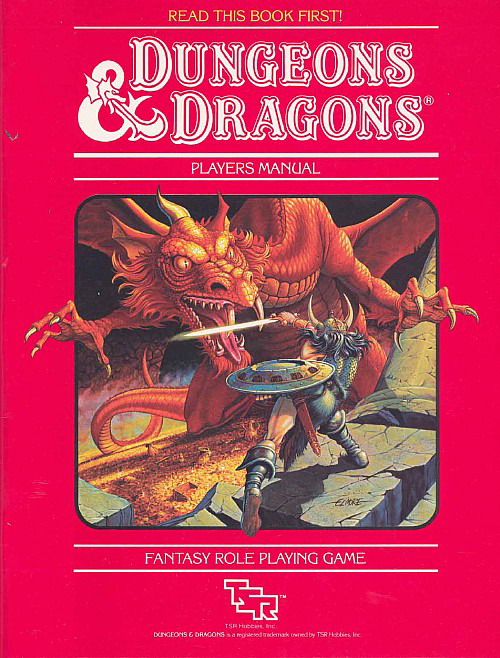
He has been on vacation apparently(the blog told me.. I do not stalk Wil Wheaton), and in his absence he has been auto-re-posting some old stories of his.  One of them was about the death of Gary Gygax because he died on March 4th, ironically DM's day(it was DM's day 7 years before his death, they are not celebrating him on his death date as I once though and have a pet peeve of).  Anyways he says that his aunt gave him the red box Dungeons and Dragons Basic set.  The set printed in 1982(the year I was born).  He never got to play with anyone, so he made characters for himself and played through dungeons on his own, by himself, in his room.


My own story about how I got into Dungeons and Dragons begins at a yard sale.  Yard sale finds of D&D are the classic method of being introduced to the game.  Several people on podcasts I listen to, and a few on blogs I've visted retell this same beginning.  My own yard sale seems almost magical in my mind now.  I am not writing that to be all mystical and stuff, I did not think of the place all that much before this.  I mainly thought of the car ride home where I read through the book.  The house that we went to was not a place we frequently went to yard sales at.  I do not remember ever going there again.  It was at this house I found it.  The house was brick, with a huge flat front yard of grass.  You could barely see the brick though because hedges covered the walls up to the windows.  It was a sunny day, but you would not be able to tell at the sale table because two MASSIVE trees sprout up near it, shading the entire huge yard underneath.

*only accurate in my mind

Anyway, I got the book, I do not remember how much but it was probably fifty cents.  I was into reading lots of Greek myth and King Arthur was like the coolest thing I had ever read about.  Also I had played through the original Dragon Warrior as well.  This book blew my mind, and I know it took me a long time to read and actually understand what it was saying.  It was the player's book, and it would be years later that I would find a DM's guide.

Anyway, I do have one thing in common with Wil Wheaton's story: I never played Basic Dungeons and Dragons.  By the time I had friends to play with me, I had a Advanced Dungeons and Dragon's book.  Being kids, we saw "Basic" and was all "well we aren't kids anymore, we need to be playing Advanced.  It is more REAL"

Wil's story inspired me to read up about our Basic set that we never played.  It all started with a man named J. Eric Holmes.  He created a book(which I actually have a copy of from the 25th Anniversary Box) that is literally the original Dungeons and Dragons paired down a bit.  It was released at a time when AD&D was out, and is thought to hearken back to the "old days" of 1977(this was around 1980... so.. yea).  Its combat was more like the old Chainmail game and did not reflect the new changes to the game that Gygax had made.

This is why Tom Moldvay came in to do his version.  Moldvay made his "basic" version much more like AD&D, and reflected how the game had grown.  Fighting-men were renamed Fighters and different weapons did different damage, just to name a few.  By now, D&D Basic was its own separate game, and to reflect that there was a sequel called D&D Expert.  Now instead of just being a beginner's game, it was a graduated set of rules that reflected not the player's skill, but the character's skill.

Big changes came between Moldvay and Mentzer's eras.  Big changes in TSR management, the ridiculously stupid Satanic Scare of the 80's, and a re-dedication to quality of product.  No longer would D&D look like something put together in a basement.  Mentzer's editions lasted through to the 90's and it "feels" like that era's AD&D books.  The layout was done with thought and care.  The artwork was done by the famous Larry Elmore and friends.  Mentzer also took the last bit of "basic is for beginners" out of the game, and wrote the game to cater to Adults rather than a child audience.

Mentzer went past Expert and brought the characters even into the "Immortal" era of traveling planes and shaking hands with gods.  There were rules for such things as governing lands that AD&D did not even cover, and people used his books to help them GM such occurrences.

So that's the story of this funny thing, Dungeons and Dragons Basic.  What started as a small intro to rules(similar to the free starter rule PDF's of today) and evolved into its own game that is remembered by famous and no-names alike.